
Just over 40 years ago, I learned how to run competitively by joining a high school cross-country team. To get any sort of hill climbing on the otherwise flat terrain of Midwest America, we’d go to the reservoirs and river valleys. One of my fondest memories was a race that took us through a forest — a sense of wilderness in contrast to running the peripheries of golf courses.
After graduating, my training and races were completely road based. My best results are long behind me, with a declining Strava curve regularly reminding me. A friend of similar age sympathised and explained that as a reason to run more on trails: “You’ll never set a personal best on a trail course, and that’s the point.”
Last summer he and I went for a short jog together in one of his favourite running spots in the French Alps. Nothing too technical, but I was grateful for my Hoka Speedgoats and their knobbly lugs. Good memories of trail running returned.
I followed up with some solo runs at some spots in Fuerteventura, suggested by others at the Strava-alternative Kamoot site. They were more technical runs up and down volcanoes and ravines, but the rewards were greater.
I knew about the UTMB events as the pinnacle of trail running season, particularly for ultramarathon runners. I never paid much attention to it, because I never intend to run 50 or 100 miles.
Out of curiosity, though, I explored some YouTube videos of those who go that distance. Running through the night doesn’t appeal to me at all. But I was excited to learn that there is a shorter, 20K race. I researched more and learned that this was introduced as a taster and to get more people into the sport.
Count me in.
I explored to discover trail races relatively nearby that I could consider. The next one on the calendar was the Mourne Skytrail 20K. I duly registered. On 11 October 2025, I will run my first official trail race.
As is the case with trail races, there is mandatory kit. Interestingly, the race organisers for the Mourne Skyrunner events are requiring the same, maximalist mandatory kit for all races, including the relatively short 20K. This noticeably exceeds what UTMB requires for its world championship for the similar distance (ETC: 15K).
Below I summarise the rationale for my kit selection.
Suitable footwear
“Road/barefoot-style shoes are not acceptable.”

I have a pair of Hoka Speedgoat 5 shoes. Positively, they are broken in and well cushioned. I found the sufficient during my recent recce runs on the course. However, I also found them slightly unstable at a couple of points. The shoes’ relatively porous upper mesh fabric enables breathability, but also allows water to enter easily. Hopefully it’s not a downpour on the day.

A teammate from the Belfast Association of Rock-climbers and Fell-runners (BARF) suggested Innov8 Mudtalon shoes, with their 8mm lugs. I’ve bought a pair, but didn’t receive them in time to break them in sufficiently. Yet they should be very good for the reliably wet and muddy trails.
Socks
Not on the mandatory kit list, but obviously essential.
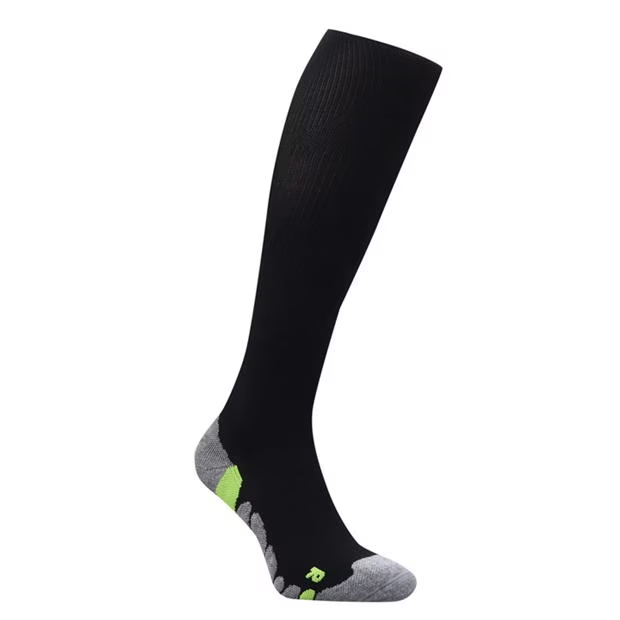
I will wear Karrimor compression socks, because I have experience using them. I like the cushioned soles and full coverage of my lower leg, without overly tight binding.
Decathlon sell compression socks, but (a) I am unfamiliar with them and (b) they appear thinner, which may prove unreliable for longer runs, particularly in the winter, when I am more likely to wear them. I may consider them for long, summer runs.
I may well pack an extra pair of socks for the race, in case of wet socks not drying out sufficiently during the run.
Shorts
Another essential item.

I own a pair of dedicated trail shorts, with half-length leggings, from Decathlon. They are now my go-to shorts for all of my trail runs. I also have two pairs without leggings, for my summer runs. I bought another pair with leggings, so that I have a stand-by ready; one pair is no longer enough.
Tops
Another essential item.
I have a variety of long-sleeve tops suitable for cooler running. I will wear one as a base layer, along with a technical t-shirt top, and finally a BARF tank top for show.

Although I have a suitable warmer long-sleeve top, which is on the Mourne Skytrail’s suggested list, I think I will invest in a Merino wool long-sleeve top. This top would be used for the sake of warmth at an aid station and/or the need to change into a dry or warmer top.
Running backpack
All of this kit has to go somewhere.
I came close to buying a standard-bearer of running backpacks, the Salomon Active Skin 12l, recommended widely in YouTube episodes from trail ultramarathon runners. However, Salomon’s latest iteration removed a top, quick-grab pocket that many liked to use to put a waterproof jacket. This was one of its USPs, as other manufacturers don’t have this (or have one that is zipped, which defeats the quick-access purpose). So, I explored other options.

I went into a local Decathlon store and was initially disappointed by the lack of elastics to hold the top of flasks. (Without these, flasks will sink to the bottom as you empty them.) I made this remark on a YouTube video, and someone replied that other Decathlon backpacks did have them. I returned and discovered its 15l version, which worked for me.
However, the advice to stuff a backpack before purchasing one is sound. While the size medium/large seemed to be a good fit in the shop, when I stuffed it with all this mandatory kit at home, I found that I was pushing the limits of the front tie straps. So, I exchanged it for the next size up, extra-large.
I like all of the pockets and their layout. So much of your kit is easily accessible. I’m not convinced about the placement of the waterproof pocket on the front (for your mobile), however. I find it a bit tight alongside a filled 500ml flask behind it.
Waterproof jacket
“Jacket with taped seams and integrated hood. Must feature a minimum hydrostatic head rating of 10,000mm.”

While I own a Decathlon waterproof jacket that has a rating of 10,000mm, lately I’ve noticed that water permeates the outer shell (but doesn’t penetrate the inside). Decathlon now sell a version that has a 20,000mm rating. Also, it has a horizontal vent split on the back, which will help a little bit with overheating. I’m impressed with the venting.
Waterproof trousers
“Trousers with taped seams. Must feature a minimum hydrostatic head rating of 10,000mm.”

I purchased a pair of Decathlon waterproof trousers recently and tested them out during a recce. They work very well, thanks to the tapering in the legs. Also, they fold into an integral pocket, for easy transport. A good purchase. Have a hydrostatic head rating of 10,000mm.
Survival bag
“Not blanket. Available to pre-order during entry or purchase at event from our store.”
I duly purchased Mourne Skyrunner’s offer of a survival bag during my race registration purchase. Appears relatively compact and lightweight, and should prove useful for future race registrations elsewhere.
First aid kit
“Minimum contents: sterile bandage, cohesive bandage, safety pins, and platers. A suitable first aid kit is available to pre-order during entry or purchase at the event from our store.”
Alas, there was not first aid kit listed for sale during race registration. I created my own first aid kit from purchases of individual items at Sainsburys.
Map and compass
“Map supplied at registration. Digital/watch compass not accepted. Ability to use both effectively to navigate.”

I bought the most basic baseplate compass at Decathlon.
I need to learn how to use it with a map. I’ve never done so before.
Whistle
Mandatory item.

While most running vests have an integral whistle, they are pathetic. I have run with a dedicated, large, flat whistle, tied on a military-style metal bead necklace for years. (If I am distressed, injured, or otherwise want to raise an alarm, a whistle could prove essential.) I will wear my whistle on race day.

Similarly, on another necklace is a metal, military-style ID tag, with my essential contact and medical information. Likewise, if I am unconscious, this could be the quickest way for medical crew to give me appropriate treatment.
Mobile phone
Mandatory item.

My Xiaomi mobile phone has an excellent camera. I will use it without the dedicated extra battery/camera pack.
Headtorch
“With sufficient light to be able to navigate in darkness.”
This is one of the items that I don’t understand why it is mandatory for the 20K run, which will start at 10.00am and has a four-hour time limit (2.00pm), which is well before it will be dark.
I inquired with the race organisers, who replied that you could take a wrong turn and be off course after sunset.
I purchased the Nitecore HA-11 headtorch, which made the claim of 4 hours at 250-lumens, using a single, AA battery. I wore it for the first time at a training session. I set it at its highest, 250-lumens setting. It lasted literally about two minutes, before powering down to a 100-lumens setting, which wasn’t strong enough for the narrow trail through a marshy field on the top of Cavehill. I relied on others’ headtorches. It was an uncomfortable experience; I would certainly not want to be caught out on my own with inadequate lighting.
Back home, I did some research and discovered on the manufacturer’s user manual that the unit will power down in the case of overheating. I found it curious that it was overheating so soon. Further research from other reviewers, including some detailed, expert analysis, show that this unit will only last two minutes at the highest setting, before reducing its output. Well, I sent back this item to the reseller for a refund.
I previously used a Decathlon 300-lumens headtorch for nighttime running. It uses an integral batter that is rechargeable by USB-mini. It is also relatively heavy at 125g.

Decathlon sell an updated version: Forclaz Rechargeable Headlamp HL500 USB v3. It lasts longer (4.5 hours at 300-lumens), rechargeable by USB-C, and is lighter at 90g. I spent £30 for the upgrade and lighter weight in my running vest.
Spare batteries
Required for the headtorch. Useful for mobile phone, too.

My other Nitecore purchase proved more reliable: Nitecore NB Air 5000mAh Ultra Lightweight and Slim Power Bank. It is lightweight at 89g and waterproof. I’ve tested it and it works fine. I’ll pack a short, USB-C to USB-C cable, which will work to recharge my mobile and headtorch (in that unlikely scenario).
1L fluid
I will probably fill one of my 500ml soft flasks with water mixed with an electrolyte tablet and another flask with just water. My stomach likes me to mix up the tastes of electrolytes versus water. I’ll also pack a spare 250ml flask with just water.
Cup/beaker
“Suitable for hot fluids. Soft-flask style are not accepted.”

I don’t know if no “soft-flask style” means you can’t use a collapsable silicon-based cup (which isn’t meant for hot fluids anyway) or collapsable silicon-based bowls (which are designed for hot fluids). Uncertain, I searched for a non-silicon solution. Happily, I discovered a small (11cm diameter x 4.5cm height), very light, hard plastic bowl in the camping section at Decathlon. I like its compact shape and it weights a mere 37g, a fraction of the typical 90g of silicon bowls.
Again, I asked the race organisers about the necessity of a bowl for hot liquid, as there are no aid stations on the 20K course. The organiser acknowledged my point a removed it from the course mandatory kit list. (I half expected, “In case you get lost and stumble upon an aid station on another course.”)
Hat and gloves
Mourne Skytrail also suggest packing a spare set. “Buff” style acceptable.
For my road runs, I usually wear ordinary beanie-style hats with gloves. I’m not used to using buff-style wraps. I tried one for a trail run recently, as a headband. (I’ve noticed recently that I have an issue with sweat getting into my eyes.) The buff worked, but it was soaked by the end of the run. So, I’ll invest in a headband.

Partially for show, I’ll buy a UTMB motif buff and sweat band. I can justify it on grounds of motivation.
My ordinary Gortex waterproof mitten overgloves are too bulky, so I got a slimmer pair at Decathlon. A two-glove system works well for me. An alternative is Salomon waterproof gloves, which have a handy flap to expose fingers, for the sake of releasing heat.
Waterproof bag

Mourne Skyrunner says “carrier bag acceptable”, but I wouldn’t consider that waterproof. My choice will be a selection of small and medium zip seal clear plastic bags.
400kcal minimum emergency fuel
An ultramarathon runner in a YouTube video suggested having 100kcal for every hour of trail walking and 200kcal for trail racing. That sounds reasonable.

After some trial and error with other brands and products, my stomach prefers High 5 energy bars. All natural, not too sweat, easy to chew, pleasant taste, and easy to digest. I’ll pack several of these.
I don’t like energy gels. I’ve tried all sorts over the years. The first one that I consume during exercise works alright, sometimes the second one. But that is all my gut will handle. I know there are more expensive, easier-to-digest versions out there. My alternative is to pack some pitted dates and dried apricots or pineapple.
£20 cash
This is the first of Mourne Skyrunner recommended (not mandatory) equipment. Useful to have in case your mobile phone dies and you need to pay for a taxi back.
Hiking/running poles
For the Mourne Skytrail 20K, I have decided that I will run without poles. I did a lot of research and I fully appreciate the benefits of running with poles. However, I simply don’t have sufficient time to learn how to use them effectively.
If I decide to buy a pair of poles, then my preferred choice will likely be Mountain King Skyrunner Aluminium poles (125cm; 137g) (£95).
Windbreaker jacket
Although not on the required list for either Mourne Skyrunner or UTMB events (except UTMB CCC 100K and above), I found it useful to run with my super lightweight Decathlon windbreaker that I’ve used for years during my cycling outings. I like how small it packs into its own pocket. I used it during a course recce effectively. It kept the chill off and was easier to utilise than the larger waterproof jacket.
I’ll publish a subsequent post, post-race.